

Views: 0 Author: Site Editor Publish Time: 2026-05-27 Origin: Site


Commercial fleet downtime directly impacts bottom-line revenue. Whether you are a heavy-duty parts wholesaler, a fleet maintenance manager, or a professional repair shop, replacing a failing transmission component with an inadequate part guarantees repeat failure and compounded labor costs. Upgrading to an aftermarket truck clutch requires moving beyond basic OEM replacements to match specific operational loads. This is especially critical when servicing European mainstream heavy trucks like Mercedes-Benz, Volvo, Scania, MAN, Mack, and Renault, as well as robust domestic workhorses like Shacman.
Selecting the correct component depends on a strict evaluation of torque capacity, friction material, and precise physical compatibility. For B2B suppliers and service providers, you should never simply source by price. This guide breaks down exactly how to evaluate commercial demands. Wholesalers will learn how to stock the right inventory, while repair shops and fleets will learn to map operational realities to hardware specifications, securing maximum uptime and peak mechanical performance.
Torque over Horsepower: Always size your aftermarket truck clutch inventory or fleet upgrade based on peak engine torque and gross combined weight rating (GCWR), not horsepower.
Material Matters: Organic friction materials suit standard long-haul logistics (e.g., Volvo or MAN highway cruisers), while ceramic composites are mandatory for high-heat vocational towing (e.g., Mack or Shacman dump trucks).
Dimensional Accuracy: Exact spec matching (e.g., 400mm diameter for European heavy-duty models) is non-negotiable for operational safety and preventing shop comebacks.
System Integrity: Repair shops must ensure a new clutch plate is never paired with a warped flywheel or failing hydraulics to protect the warranty and client relationship.
OEM clutches target general, median-use cases. Manufacturers design them to handle average loads, prioritizing driver comfort over raw holding power. However, fleets constantly push these limits. Introducing heavier freight, navigating steep mining terrains, or utilizing aggressive engine tuning pushes stock clamping force past its designed limit. When fleets increase the GCWR, factory pressure plates struggle to maintain grip, leading to dangerous on-road failures.
Repair professionals must distinguish between normal wear and operational mismatch during inspections. Glazing indicates excessive heat buildup, often seen when standard clutches are used in heavy construction applications. Mechanical slipping under peak load usually points to inadequate clamping force, commonly reported by drivers climbing steep grades where RPMs spike but vehicle speed remains stagnant.
For fleet managers and repair shops, frame the higher upfront cost of premium aftermarket parts against inevitable shop time. A transmission drop on a Scania or Mercedes-Benz demands intense labor. Investing in robust heavy-duty upgrades prevents repetitive breakdowns, eliminating the cascading revenue losses associated with chronic mechanical slipping.
Wholesalers cannot offer a universal heavy-duty replacement, and repair shops cannot install a one-size-fits-all kit. Standard freight operations using Renault or Volvo long-haul rigs prioritize consistency and driver fatigue reduction. These applications require smooth engagement to navigate distribution centers safely.
Conversely, vocational loads demand an entirely different approach. Shacman dump trucks, Mack logging rigs, and heavy equipment haulers operate under severe stress, stopping and starting repeatedly on steep, uneven terrain. Focus here must be on raw holding power and high thermal capacity to resist fading during low-gear engagements.
Industry experts rely on the "Safety Factor" metric. Repair shops should calculate necessary torque capacity using a strict buffer formula: take the peak engine torque and add a 15–20% safety margin. If a MAN engine produces 1,850 lb-ft of torque, specify a system rated for at least 2,150 lb-ft to prevent slippage on unexpected grades.
Material science dictates drivetrain performance under stress. Wholesalers must stock, and repair shops must recommend, the exact friction material matching the fleet's hauling profile.
Built from woven fiberglass, metallic fibers, and heat-resistant resins, organic discs are the industry standard for light to medium-duty operations.
Pros: Exceptionally smooth engagement with minimal flywheel wear. Ideal for standard logistics fleets operating Volvo or Mercedes-Benz highway trucks.
Cons: Unsuitable for heavy, consistent towing; they glaze and burn rapidly under high heat.
Engineered for extreme abuse, ceramic pucks sacrifice driving comfort for raw mechanical bite.
Pros: Unmatched heat tolerance and rapid dissipation. Essential for Shacman or Mack vocational trucks handling extreme payloads.
Cons: Can cause engagement chatter and accelerate flywheel wear.
A middle ground requiring precise manufacturing and careful driver handling.
Pros: Extremely long service life and excellent heat resistance with smoother engagement than ceramic.
Cons: Requires a strict break-in period; unforgiving if glazed early by poor pedal habits.
Material Type | Heat Tolerance | Engagement Feel | Ideal Fleet Application |
|---|---|---|---|
Organic | Low to Medium | Very Smooth | Highway Freight (Volvo, Mercedes, MAN) |
Ceramic/Metallic | Very High | Aggressive (Chatter) | Heavy Towing & Vocational (Mack, Shacman) |
Kevlar | High | Moderate to Smooth | Mixed Duty (Strict Break-In Required) |
For parts distributors and mechanics, precise dimensional tolerances prevent catastrophic drivetrain failures. A larger surface area dissipates thermal energy much faster, protecting European heavy-duty gearboxes. You must accurately verify the transmission input shaft splines; a mismatched spline count will prevent installation and risk damaging expensive European transmissions.
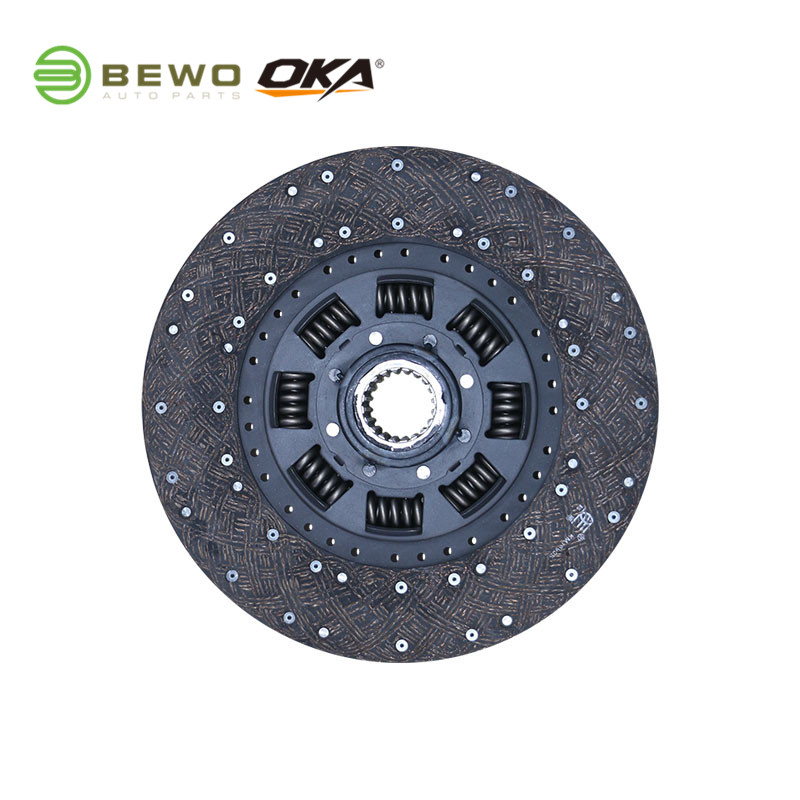
Use standard heavy-duty specifications as benchmarks. For instance, drivetrain specialists frequently stock and install the Sachs 1862379031 400mm Truck Clutch Plate. This specific 400mm dimension is heavily utilized across Mercedes-Benz, Scania, and MAN models, providing the immense surface area required to manage thermal spikes during long, grinding inclines.
Vibration absorption is equally critical to protect high-torque diesel engines. Technicians highlight heavy-duty damping springs, utilizing reference parts like the 1862193105 400mm Heavy Duty Truck Clutch Disc for premium vibration absorption, which is particularly effective in high-stress applications like Shacman dump trucks.
Remember: simply providing a larger Clutch Plate does not guarantee higher torque capacity. Repair shops must upgrade the pressure plate's diaphragm spring to achieve higher clamping force, ensuring a synchronized system upgrade.
Even the highest quality components supplied by wholesalers will self-destruct if installed incorrectly by a shop. Mechanical upgrades require strict adherence to standard machining practices to prevent costly warranty claims and fleet comebacks.
The flywheel mandate remains absolute. A brand new component will not seat correctly on an un-machined flywheel. Repair shops must resurface or replace the flywheel, paying strict attention to runout tolerances to prevent engagement chatter. Furthermore, high clamping force pressure plates radically alter pedal dynamics. Assess and upgrade the hydraulic linkage (master/slave cylinders) simultaneously to prevent blown seals on older rigs.
Shops must set transparent expectations with fleet managers regarding the break-in period for high-performance materials:
Verify hydraulic travel post-installation.
Advise fleets to drive the vehicle empty for the first 100 miles.
Recommend 500+ miles of moderate stop-and-go driving without aggressive slipping.
Introduce heavy payloads only after completing this mating cycle.
Selecting the right aftermarket truck clutch for European and robust domestic models is a calculated B2B decision balancing torque capacity, material science, and fleet demands.
Prioritize GCWR and apply the 15-20% safety factor buffer for heavy hauling applications.
Wholesalers should stock organic for highway fleets (Volvo/Renault) and ceramic/Kevlar for extreme vocational stress (Mack/Shacman).
Consult exact OEM cross-reference numbers to ensure perfect fitment, operational safety, and full commercial warranty compliance.
A: Single discs are sufficient for moderate loads typical of standard logistics. Dual-disc setups drastically increase friction surface area and torque capacity without requiring an excessively heavy pedal. Repair shops highly recommend dual-discs for heavy-duty towing, logging, and Shacman mining operations.
A: While possible, it is not recommended for standard Volvo or Scania highway cruisers. Ceramic materials offer aggressive engagement, causing severe chatter. They accelerate flywheel wear and increase driver fatigue, making them better suited for pure vocational environments.
A: Immediate slippage points to implementation errors rather than part defects. Common causes include failure to resurface the flywheel, improper break-in procedures glazing the disc, or installing a mismatched pressure plate lacking the clamping force required for the fleet's running weight.


