

Views: 0 Author: Site Editor Publish Time: 2026-07-15 Origin: Site


Projected 2026 shifts in heavy-duty drivetrain maintenance require fleet managers to adapt to raw material inflation affecting steel and sintered friction materials. Supply chain stabilization alters the availability and procurement strategies for premium components. Unplanned drivetrain failures severely impact operating margins. Opaque parts availability, extended labor downtime, and complex towing logistics disrupt cost-per-mile metrics and overall fleet efficiency. This guide provides an evidence-based framework for evaluating replacement procedures, comparing OEM versus aftermarket components, and standardizing procurement for heavy-duty applications. By understanding the mechanical and operational variables involved in drivetrain maintenance, maintenance directors can optimize replacement cycles and mitigate the risks associated with catastrophic component failure. We focus on practical, field-tested strategies to keep trucks on the road and out of the service bay.
Baseline Cost Projections: Total replacement costs (parts and labor) for commercial Class 6 to Class 8 applications are projected to vary in 2026, heavily dependent on vehicle class, transmission type (Manual vs. AMT), and component tier.
Labor vs. Parts Ratio: Labor accounts for approximately 40-50% of the total replacement cost, making first-time installation accuracy and component longevity critical to ROI.
Application-Specific Sourcing: Utilizing exact-match components—such as specific 400mm discs for European models—reduces calibration errors and prevents premature transmission wear.
Long-Term Value: Upfront savings on sub-standard friction materials frequently result in negative returns due to accelerated flywheel wear and secondary replacement cycles.
Establishing accurate maintenance budgets for Class 6 through Class 8 vehicles requires a clear understanding of the variables driving drivetrain repair expenses. Fleet managers and owner-operators must account for fluctuating material costs and regional labor variations to maintain profitable operations. You need to know exactly what goes into the repair bill before authorizing the teardown.
The market segments into Original Equipment Manufacturer (OEM) parts, Original Equipment Supplier (OES) alternatives, and various aftermarket options. OEM components guarantee exact specification matches but carry a premium. OES alternatives often roll off the same assembly lines as OEM parts. They provide identical engineering tolerances without the dealership markup. Aftermarket options vary widely in quality, from robust heavy-duty upgrades to budget-focused replacements.
Market trends for 2026 indicate a widening gap between premium friction discs and entry-level alternatives. Complete kits containing the disc, cover, release bearing, and pilot bearing generally offer better value and reliability than piecemeal component sourcing. Replacing the entire assembly simultaneously prevents older, worn components from compromising the new friction surface. We always recommend swapping the full kit to avoid pulling the transmission twice.
Component Tier | Quality Level | Best Application |
|---|---|---|
OEM | Factory Exact | Vehicles under factory warranty |
OES | Factory Equivalent | Out-of-warranty fleet vehicles |
Premium Aftermarket | High to Severe Duty | Heavy-haul and vocational trucks |
Budget Aftermarket | Variable | Light-duty or short-term use |
Labor represents a substantial portion of any drivetrain overhaul. A standard commercial manual transmission requires approximately 8 to 12 flat-rate hours for a complete assembly swap. Automated Manual Transmissions (AMTs) often demand up to 14 hours due to the complex removal of servo actuators and subsequent electronic recalibration procedures. You cannot rush this process without risking severe misalignment.
Regional labor rate fluctuations significantly impact the final invoice. Dealerships typically charge higher hourly rates but provide specialized diagnostic equipment and factory-trained technicians. Independent shops may offer lower labor rates. Fleet managers must verify their capability to handle specific AMT software calibrations and heavy-haul alignment tolerances before handing over the keys.
Medium-duty delivery vehicles (Class 6) utilize lighter-duty components, resulting in lower overall replacement expenses. These vehicles generally operate in regional or urban environments. They prioritize smooth engagement over extreme torque capacity. Heavy-duty line-haul and severe-service trucks (Class 8) require massive clamping force to manage high gross vehicle weights.
Severe-duty applications, such as logging or heavy-haul transport, often utilize twin-plate or triple-plate systems. These multi-plate configurations multiply the friction surface area to handle extreme torque loads. They inherently increase the component complexity and replacement labor required. Mechanics must carefully align multiple splines during installation.
A successful replacement extends beyond the primary friction disc. Flywheel resurfacing or complete replacement is mandatory to ensure proper friction mating. Installing a new disc against a glazed or heat-checked flywheel guarantees premature failure and harsh engagement characteristics. We never skip the flywheel resurfacing step.
Reusing pilot bearings, release forks, cross-shaft bushings, and rear main crankshaft seals introduces severe financial risk. A failed pilot bearing can destroy the transmission input shaft, necessitating a complete transmission teardown. Emergency road service and towing premiums compound these losses if a compromised component fails catastrophically in transit.
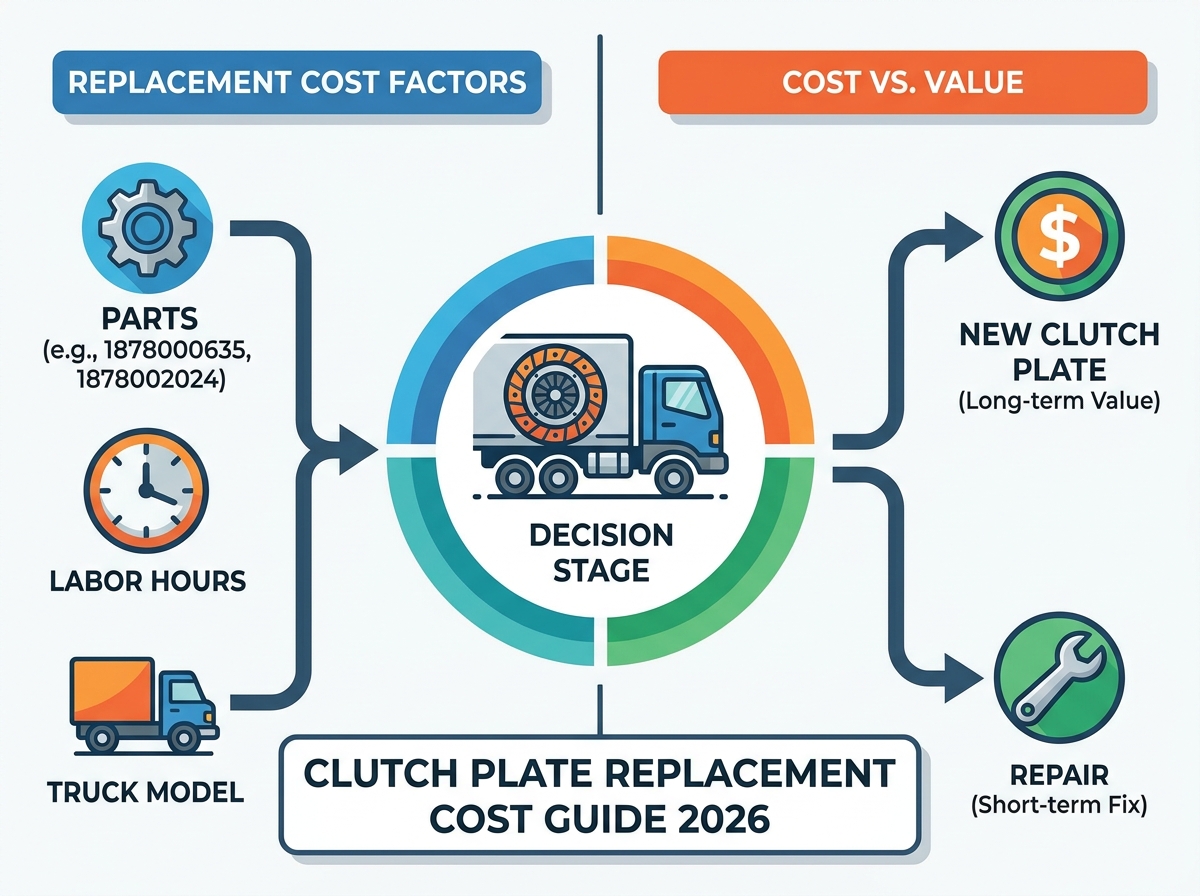
Selecting the correct truck clutch requires matching technical specifications to operational realities. Component design directly dictates vehicle uptime, driver fatigue, and drivetrain longevity. You must match the hardware to the specific route and load profile.
Friction material dictates how the assembly handles heat and engagement. Organic materials offer smooth engagement and are ideal for regional transit or medium-duty applications where stop-and-go driving is common. However, they lack the thermal threshold required for extreme loads. They will burn up quickly under heavy strain.
Ceramic or sintered metallic materials withstand massive heat generation without fading. These multi-pad designs dominate heavy-haul and vocational applications. Kevlar compounds provide a middle ground. They offer higher heat resistance than organic materials while maintaining smoother engagement characteristics than aggressive ceramic pads.
Assess the maximum gross vehicle weight rating for the specific truck.
Determine the primary operating environment (highway vs. urban stop-and-go).
Select organic materials for light loads and smooth shifting.
Select ceramic materials for heavy-haul and high-heat applications.
Select Kevlar for a balance of durability and driver comfort.
Engine harmonics and torsional vibrations can destroy transmission synchronizers and input shafts if left unchecked. Advanced spring configurations and pre-dampeners located in the disc hub absorb these destructive frequencies before they travel down the driveline. This protects the expensive internal gears.
Proper torsional dampening extends transmission life and reduces gear rattle. High-quality dampening springs resist fatigue over hundreds of thousands of miles. They ensure the transmission remains isolated from the harsh firing pulses of modern high-torque diesel engines. Weak springs lead to catastrophic hub failure.
Heavy-duty vehicles utilize either push-type or pull-type actuation systems. Push-type systems use a release bearing that pushes against the diaphragm spring fingers to disengage the drivetrain. Pull-type systems, common in heavy-duty applications, pull the release bearing away from the flywheel.
Pull-type configurations often provide higher clamping force for a given pedal effort. The health of the mechanical linkage or hydraulic actuator directly influences longevity. Worn cross-shafts or failing hydraulic master cylinders prevent full disengagement. This leads to rapid synchronizer wear and friction material glazing.
European and global fleet applications frequently rely on standardized 400mm components to manage high torque outputs. Understanding the engineering behind these specific assemblies ensures proper application matching. You cannot guess when it comes to spline counts and hub diameters.
The 1878000635 400mm Clutch Plate is engineered for demanding heavy-haul regional and long-haul transport. This component features precise spline counts—typically 10T, 18T, or 24T depending on the exact transmission input shaft. This ensures zero lash and maximum power transfer from the engine to the wheels.
Engineers optimize the friction coefficient on this specific part to balance aggressive torque holding with manageable engagement. Under standard freight conditions, this plate delivers an exceptional lifecycle. The robust hub design resists the extreme torsional shear forces generated during low-speed, high-load maneuvers. We see excellent longevity when installed correctly.
Exact-fit compatibility is non-negotiable for modern European platforms. The 1878002024 Clutch Disc 400mm for Mercedes-Benz Trucks integrates seamlessly with Actros and Arocs platforms. This component meets OEM-level performance metrics, specifically regarding automated manual transmission (AMT) integration like the PowerShift 3 system.
Pneumatic actuation compatibility requires precise diaphragm spring rates. Specialized lining wear sensors integrated into these European 400mm setups communicate directly with the vehicle's control modules. This electronic integration allows the AMT to adjust its engagement parameters dynamically as the friction material wears down over time. It keeps the shifts crisp and accurate.
Improper installation introduces severe operational hazards. Mitigating these risks protects the initial hardware investment and prevents catastrophic roadside breakdowns. A rushed job in the shop always leads to a tow truck call later.
Technical indicators of a failing system include slipping under heavy load, clutch brake failure, hard shifting, and physical chatter during engagement. Identifying these symptoms early prevents the friction material from disintegrating and damaging the flywheel or transmission housing. Drivers must report these issues immediately.
Modern AMTs utilize electronic diagnostic routines to monitor system health. Technicians use electronic service tools to measure wear stroke and actuator travel. Monitoring these data points allows fleets to schedule maintenance proactively rather than reacting to a stranded vehicle. Data-driven maintenance saves thousands in recovery fees.
Heavy-duty dual-plate or single-plate systems demand strict alignment tolerances. Technicians must perform input shaft runout checks to ensure the transmission and engine block are perfectly parallel. Misalignment causes rapid hub spline wear and catastrophic spring failure. We use specialized alignment tools for every job.
Automated Manual Transmissions require rigorous software recalibration post-installation. Technicians must reset the kiss-point and engagement adaptation values in the transmission control module. Failing to perform this software calibration causes the AMT to slip or slam into gear. This destroys the new friction material rapidly.
Evaluating supplier warranties requires analyzing mileage limits, time limits, and severe-duty exclusions. Reputable vendors stand behind their components but require proof of proper installation. You must read the fine print before purchasing bulk orders.
Documented installation procedures are mandatory to prevent warranty voidance. Shops must maintain records of flywheel runout measurements, pilot bearing replacement, and AMT software calibration logs. Thorough vendor vetting ensures fleets partner with suppliers who provide robust technical support alongside their hardware.
Choosing premium components over budget alternatives relies on sound financial logic. The initial purchase price represents only a fraction of the total operational expense. You have to look at the big picture to run a profitable fleet.
Evaluating the true value of a clutch plate requires calculating the Cost Per Mile (CPM). The formula divides the total parts and labor costs by the component's lifespan in miles. A premium OES solution with a higher initial cost frequently yields a significantly lower CPM than a budget aftermarket disc that fails prematurely.
Budget components often utilize inferior friction materials and weak dampening springs. When these parts fail early, the fleet incurs a second round of massive labor expenses and lost revenue from vehicle downtime. This entirely negates any upfront savings. Do it right the first time.
Standardizing drivetrain components across mixed fleets streamlines maintenance operations. Fleet managers can negotiate bulk procurement strategies to secure critical high-wear parts. This ensures they are available immediately when a truck enters the shop.
Stocking 400mm discs and complete assembly kits internally reduces supply chain delays. Having the right parts on the shelf eliminates the waiting period for external deliveries. It allows technicians to turn bays faster and return vehicles to revenue-generating service.
Investing in exact-match, high-tier components yields the most efficient long-term operational metrics. Prioritizing quality hardware prevents secondary failures and excessive downtime. Select components based on specific vehicle application, gross vehicle weight rating, and transmission type. A heavy-haul vocational truck requires vastly different friction materials than a regional delivery vehicle.
Audit your current fleet to identify vehicles approaching their expected drivetrain maintenance intervals.
Consult with a certified heavy-duty parts specialist to verify exact part numbers via VIN lookups.
Standardize your procurement process to prioritize OES or premium aftermarket kits over piecemeal components.
Implement mandatory software recalibration protocols for all AMT installations in your shop.
A: Lifespan varies heavily by application. Line-haul trucks operating primarily on highways can expect 250,000 to over 500,000 miles. Regional stop-and-go delivery or severe-duty vocational trucks experience significantly shorter lifespans due to constant engagement cycles and high heat generation.
A: Slipping occurs due to a loss of friction material depth, weakened pressure plate diaphragm springs, or glaze formation from severe overheating. Additionally, oil contamination from a leaking rear main engine seal or transmission input shaft seal will instantly cause slipping.
A: No. Installing a new friction disc against an un-machined, glazed, or heat-checked flywheel prevents proper mating. This guarantees harsh engagement, premature wear, and immediately voids manufacturer warranties. Always resurface or replace the flywheel.
A: The 1878000635 features OEM-level torsional dampening, exact spline tolerances, and high-performance friction material formulations tailored specifically for European heavy-duty trucks. Standard aftermarket options often compromise on spring quality and friction coefficients.
A: Standard flat-rate estimates range from 8 to 14 hours. Cab-over configurations and Automated Manual Transmissions (AMTs) require more time due to the removal of electronic servo actuators, complex linkages, and mandatory post-installation software calibrations.
A: Yes. AMTs require specific torsional dampening characteristics, exact spline tolerances, and compatibility with electronic actuation systems. The friction material must integrate perfectly with the transmission control module's programmed engagement parameters.


