

Views: 0 Author: Site Editor Publish Time: 2026-07-08 Origin: Site


The operational lifespan of a commercial truck clutch system is disproportionately dictated by thermal management and mechanical rigidity. Both factors fundamentally depend on the material composition of the clutch cover. Fleet managers and drivetrain engineers face a strict trade-off between heat dissipation, component weight, and absolute tensile strength when specifying replacement parts or OEM builds. Premature failure due to warping or heat checking leads to unscheduled downtime and inflated maintenance costs. Resolving this requires a technical evaluation of the two dominant material architectures: cast or stamped steel versus cast aluminum. This guide breaks down the metallurgical realities, performance outcomes, and application-specific criteria for selecting the optimal component for heavy vehicle operations.
Thermal Dynamics: Aluminum clutch covers dissipate heat up to three times faster than steel, significantly reducing friction disc fade in high-shifting environments.
Structural Durability: Steel remains the industry standard for maximum tensile strength and resistance to extreme torque loads in heavy-haul and vocational applications.
Payload and Efficiency: The weight reduction offered by aluminum covers translates to lower rotational mass (Moment of Inertia), marginally improving fuel efficiency and freeing up payload capacity.
The baseline function of the cover involves housing the pressure plate and the diaphragm spring or coil springs. It provides the structural mounting point to the flywheel. A reliable truck clutch relies on this housing to maintain absolute dimensional stability under immense stress. Any physical distortion compromises the entire driveline engagement process. When you bolt a cover to a flywheel, you expect it to hold its shape perfectly. If the housing warps even a few thousandths of an inch, the internal geometry shifts. This shift alters how the pressure plate contacts the friction disc. You lose the flat, even mating surface required for maximum friction. Uneven contact creates hot spots. Hot spots lead to micro-welding and eventual catastrophic failure of the friction material.
Materials must resist deflection under extreme clamp loads. Heavy commercial applications demand thousands of pounds of clamping force. Engines producing 1,850 to 2,050 lb-ft of torque require massive spring pressure to prevent slipping. Any flex in the cover reduces the effective clamping force applied to the friction disc. This loss of force causes clutch slip, rapid heat generation, and accelerated wear on mating surfaces. Think about a truck pulling 80,000 pounds up a 6% grade. The driveline is under maximum load. If the housing flexes backward under the pressure of the diaphragm spring, the clamp load drops. A drop from 3,600 lbs of clamp force to 3,200 lbs might be all it takes to initiate a slip event. Once it slips, temperatures spike instantly.
Cover rigidity directly influences pedal travel and driver feedback. A stiff housing ensures linear spring actuation. This consistency improves the engagement and disengagement feel. Drivers rely on predictable modulation to maneuver heavy loads safely at low speeds. Flexing covers create a spongy pedal feel and erratic engagement points. When a driver backs a loaded trailer into a tight dock, they need precise control. If the housing flexes, the release bearing travel does not translate directly to pressure plate movement. The driver feels a disconnect. They might stall the engine or over-rev and slip the assembly. Consistent rigidity guarantees that one inch of pedal travel always equals the exact same amount of release bearing travel.
Rotational forces exert massive stress on heavy-duty components at high RPMs. The housing must withstand these outward centrifugal forces without fracturing. Precise dynamic balancing is non-negotiable. Imbalanced rotational mass generates severe drivetrain vibrations. These vibrations can destroy transmission input shaft bearings and engine main bearings over time. A 15-inch assembly spinning at 2,100 RPM generates immense kinetic energy. If the casting has voids or uneven wall thickness, the imbalance acts like a hammer on the driveline. You will feel it in the cab, and the transmission will feel it in the input shaft. Over time, this harmonic vibration backs out bolts, cracks bell housings, and destroys pilot bearings.
Component Function | Mechanical Requirement | Failure Consequence |
|---|---|---|
Pressure Plate Housing | Zero dimensional distortion under load | Uneven friction disc wear, hot spots |
Spring Containment | Absolute rigidity against spring pressure | Loss of clamp load, driveline slip |
Flywheel Mounting | Flat, secure mating surface | Vibration, bolt shear, housing fracture |
Rotational Mass | Perfect dynamic balance | Input shaft bearing failure, NVH issues |
Manufacturers utilize different steel grades based on application demands. Light-to-medium duties often rely on stamped carbon steel. Commercial trucking requires Spheroidal Graphite (SG) ductile iron or heavy-gauge cast steel. These heavy-duty alloys provide exceptional yield strength. They offer superior fatigue resistance under continuous cyclical loading. The dense molecular structure prevents micro-fractures during millions of engagement cycles. SG iron is particularly effective because the graphite nodules stop crack propagation. If a microscopic stress riser forms, the nodule arrests it before it splits the casting. This makes ductile iron incredibly resilient in high-shock environments, like logging roads or construction sites where driveline shock is a daily reality.
High rigidity ensures zero clamp load loss. This translates directly to reliable torque transfer in high-GCWR (Gross Combined Weight Rating) scenarios. Steel housings do not flex under heavy acceleration. However, steel acts as a massive heat sink. This creates a "thermal flywheel" effect. Prolonged slipping generates heat that steel struggles to shed quickly. Retained heat potentially leads to surface glazing of friction linings. It causes heat spots or severe warping of the pressure plate. When you slip a heavy assembly to get a load moving, temperatures at the friction interface can exceed 800 degrees Fahrenheit. Steel absorbs this heat slowly and releases it even slower. If you have multiple stop-and-go events in a short period, the heat stacks up. The assembly never gets a chance to cool down.
Certain operational profiles demand the uncompromising strength of steel. You cannot substitute materials when absolute structural integrity is the primary requirement. We see this constantly in off-highway and severe-duty applications.
Vocational trucks operating in severe conditions, including dump trucks, logging rigs, and refuse collectors.
Heavy-haul transport where absolute structural integrity supersedes weight savings.
Oversized load applications demanding maximum torque transfer without housing deflection.
Agricultural transport vehicles navigating soft, muddy terrain requiring high-RPM clutch drops.
Mining operations where equipment runs continuously under maximum payload.
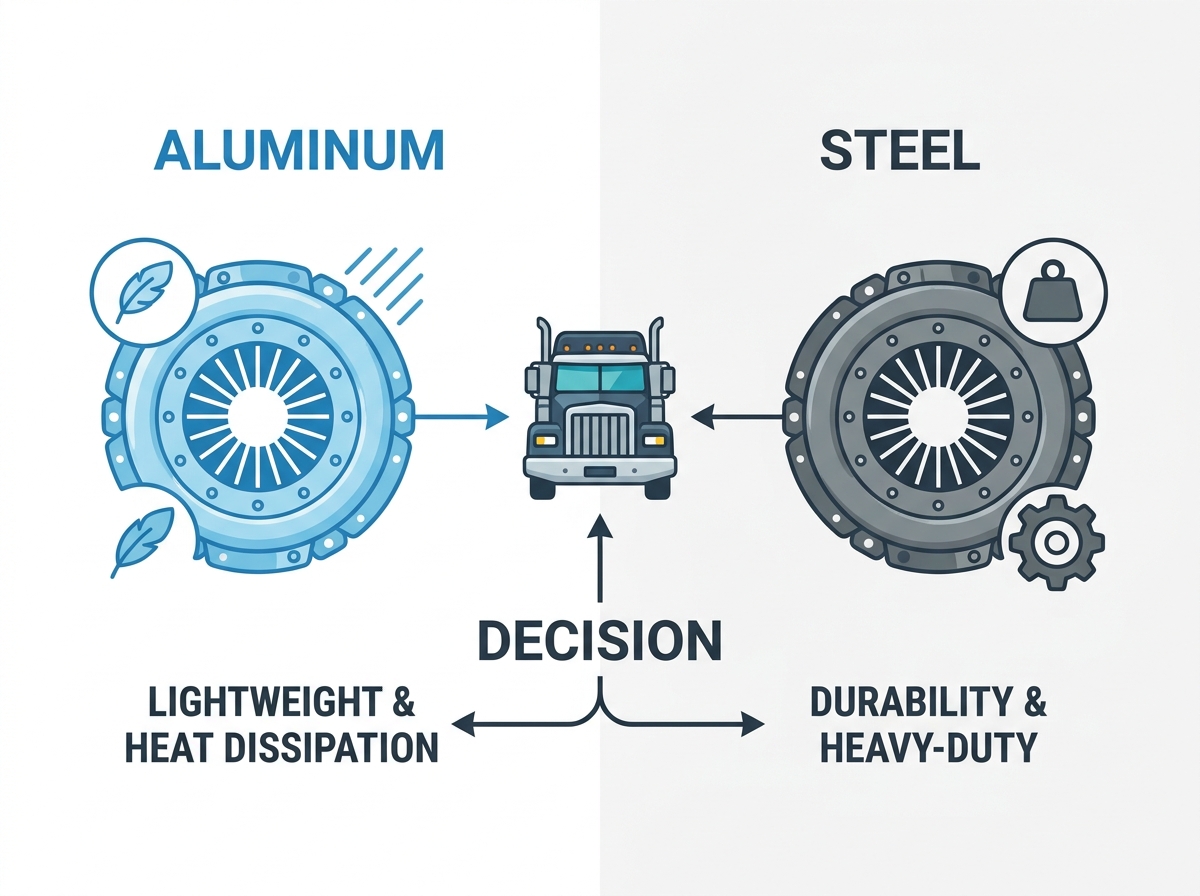
High-performance applications utilize aerospace-grade cast aluminum alloys like A356-T6. Some specialized builds use CNC-machined 6061-T6 billet aluminum. Aluminum is inherently softer than steel. Manufacturers must integrate steel inserts, wear pads, and hardened steel guide pins at critical contact points. These reinforcements protect pivot rings and mounting flanges. They prevent galling, premature wear, and localized mechanical failure on the softer aluminum surface. You cannot just cast an aluminum shell and call it a day. The release bearing linkage and the diaphragm spring pivot points exert highly concentrated loads. Without hardened steel inserts, the aluminum would gall and deform within a few thousand miles. Engineering a reliable aluminum clutch cover for truck applications requires a hybrid material approach.
Superior thermal conductivity rapidly pulls heat away from the friction interface. This rapid cooling extends the life of the clutch disc. It drastically reduces fade during aggressive maneuvering or heavy stop-and-go traffic. Furthermore, a lighter cover reduces the Moment of Inertia (MOI). Lower rotational mass reduces parasitic drag on the engine. This improves throttle response and speeds up shift synchronization times. It also reduces torsional stress on the transmission input shaft. When you drop 20 or 30 pounds of rotating mass off the back of the crankshaft, the engine revs faster. The transmission synchronizers do not have to work as hard to match shaft speeds. This translates to smoother, faster shifts and less wear on the transmission internals.
Aluminum shines in environments where heat dissipation and weight reduction offer tangible operational benefits. It is not for every truck, but it excels in specific duty cycles.
Stop-and-go urban delivery routes experiencing high shifting frequency.
Weight-sensitive bulk hauling operations.
Applications where every pound saved equates to increased revenue-generating payload.
Express freight operations running automated manual transmissions (AMTs) that require fast shift times.
High-altitude routes where thinner air reduces natural convective cooling of the bell housing.
Aluminum boasts significantly higher specific heat capacity and thermal conductivity metrics compared to steel. It sheds heat rapidly. This mitigates the risk of thermal distortion despite aluminum having a lower melting point. Steel offers high absolute heat tolerance but suffers from a slow cooling rate. Trapped heat in steel housings frequently destroys friction material before the housing itself fails. Think of aluminum as a radiator and steel as an oven. The aluminum pulls the heat out of the pressure plate and dissipates it into the air circulating inside the bell housing. Steel absorbs the heat and holds it against the friction disc. In a high-shift environment, the aluminum assembly will run hundreds of degrees cooler than a comparable steel unit.
Maintaining a 3,000+ lb clamp load requires immense structural rigidity. Steel naturally provides this strength with a relatively thin cross-section. Aluminum covers must be cast thicker to match this baseline rigidity. Engineers utilize strategic structural ribbing in aluminum designs. This ribbing adds strength without sacrificing the weight advantage. A properly engineered aluminum housing will not deflect under load. However, the physical footprint of the aluminum cover is often bulkier. You have to ensure there is adequate clearance inside the bell housing. The thick structural ribs required to prevent deflection take up space. If the casting is too thin, the housing will flex, and you will lose clamp load.
Thermal expansion differences create operational challenges. Aluminum expands at roughly twice the rate of steel. This expansion can affect the release clearance, known as the air gap, at high operating temperatures. Engineers must account for this CTE mismatch. Improperly designed aluminum housings can cause dragging or incomplete disengagement when the driveline reaches maximum operating temperature. When the aluminum housing expands, it moves the pivot points of the diaphragm spring. If the design does not compensate for this movement, the release bearing travel will not fully disengage the pressure plate. You end up with a dragging driveline, hard shifting, and accelerated synchronizer wear.
Natural material properties heavily influence NVH (Noise, Vibration, and Harshness). Cast iron and heavy steel offer superior internal dampening of engine harmonics. Their dense mass absorbs harsh vibrations. Aluminum tends to transmit high-frequency drivetrain vibrations. Fleets highly sensitive to NVH may prefer the dampening characteristics of traditional cast iron housings. Diesel engines produce massive torsional vibrations. Every time a cylinder fires, it sends a shockwave down the crankshaft. A heavy steel housing acts like a secondary harmonic balancer. It absorbs and dampens those shockwaves. Aluminum, being lighter and less dense, allows more of that vibration to pass through to the transmission.
Evaluation Metric | Steel / Ductile Iron | Cast / Billet Aluminum |
|---|---|---|
Thermal Conductivity | Low (Retains heat) | High (Dissipates heat rapidly) |
Tensile Strength | Exceptional (Thin cross-section) | Moderate (Requires thick structural ribbing) |
Weight (MOI) | Heavy (High parasitic drag) | Lightweight (Fast synchronization) |
Harmonic Dampening | Excellent (Absorbs engine vibration) | Poor (Transmits high-frequency NVH) |
Thermal Expansion (CTE) | Low (Stable air gap) | High (Requires engineered compensation) |
Mounting an aluminum cover to a cast iron or steel flywheel introduces galvanic corrosion risks. Dissimilar metals react when exposed to moisture and road salts. Mitigation strategies include specialized barrier coatings and plated hardware. Additionally, thermal expansion cycles in aluminum can affect self-adjusting mechanisms. Automatic wear-compensation mechanisms require precise calibration. Rapid expansion and contraction may disrupt solo-style clutches if not specifically engineered for aluminum housings. If you run a truck in the rust belt, salt spray gets inside the bell housing. The aluminum and steel interface acts like a battery. The aluminum corrodes rapidly, pitting the mounting flange and weakening the bolt holes. You must use anti-seize compounds and barrier plates to isolate the metals.
Inspection protocols vary by material. You cannot treat an aluminum housing the same way you treat a steel one. The failure modes look completely different.
Inspect steel housings for heat cracks radiating from the center opening.
Check steel pressure plates for blue or purple discoloration indicating severe overheating.
Examine the diaphragm fingers on steel units for excessive wear at the release bearing contact point.
Inspect aluminum housings for stress fractures around the mounting bolt holes.
Check the steel inserts on aluminum covers for looseness or galling.
Look for white powdery residue on aluminum mounting flanges, indicating galvanic corrosion.
Verify that the structural ribbing on aluminum castings shows no signs of impact damage from road debris.
A reputable truck clutch covers manufacturer must utilize rigorous QA processes. High-RPM burst speed testing is mandatory. This verifies structural limits up to two or three times the rated engine redline. Dynamic balancing ensures smooth operation. Clamp load retention testing over millions of cycles proves the design's longevity. Look for ISO 9001 or IATF 16949 certifications. These standards ensure strict metallurgical consistency across production batches. You want a manufacturer that tests their products to destruction. If an engine runs away and hits 3,500 RPM, you need to know the housing will not explode and tear through the floorboard. Burst testing provides that safety margin.
Raw material sourcing directly impacts component safety. Avoid manufacturers utilizing recycled alloys with high porosity. Porous metal drastically reduces the burst strength of heavy-duty truck clutch covers. Catastrophic failure at highway speeds poses severe safety risks. Demand transparent material traceability. Strong warranty structures and accessible post-sale technical support indicate a manufacturer's confidence in their engineering and material selection. When you buy a replacement part, ask for the material certs. If the supplier cannot tell you exactly what grade of aluminum or steel they use, walk away. Porosity in a casting is invisible to the naked eye, but it acts like a perforated line on a piece of paper, just waiting to tear under stress.
Audit current failure modes across your fleet immediately to identify heat or stress-related patterns.
Specify aluminum housings for route profiles experiencing high shifting frequency and friction disc burn-up.
Mandate heavy-duty steel housings for vocational trucks operating in high-torque, heavy-haul environments.
Implement strict galvanic corrosion prevention protocols when installing aluminum components on steel flywheels.
Request detailed material specification sheets and burst test reports from your manufacturer before the next procurement cycle.
A: Yes, provided the aluminum cover is dimensionally identical and rated for the same torque and clamp load. You must verify that the flywheel is compatible. Ensure that drivetrain harmonics and galvanic corrosion mitigations are properly addressed before installation.
A: While aluminum has a lower melting point, its superior heat dissipation usually prevents the localized heat buildup that causes warping. However, under severe abuse without adequate cooling time, an aluminum housing can fail.
A: Steel and cast or ductile iron offer the highest ratio of tensile strength and resistance to deflection relative to manufacturing cost. This makes steel the most reliable and economical choice for standard heavy-duty applications where weight is not the primary concern.
A: The material dictates thermal management and structural deflection. Better heat dissipation from aluminum extends friction material life. Higher rigidity and thermal mass from steel ensures consistent clamp load over millions of heavy-load cycles.
A: Look for documented burst testing reports and dynamic balancing certificates. Verify their ISO/IATF quality standards. Transparent raw material sourcing is crucial to ensure the cover will not fail catastrophically under extreme torsional stress.


