

Views: 0 Author: Site Editor Publish Time: 2026-08-10 Origin: Site


Misdiagnosing heavy-duty drivetrain issues leads to catastrophic component failure, extended fleet downtime, and inflated labor costs. This happens frequently in commercial trucking applications. Truck clutch parts wholesalers, fleet managers, and heavy-duty repair shops often struggle to isolate whether engagement issues stem from the friction material or the clamping mechanism. This diagnostic confusion results in inefficient procurement, incorrect parts ordering, and repeated transmission teardowns. Understanding the distinct mechanical roles, wear patterns, and failure symptoms of the clutch plate versus the pressure plate solves this problem. Proper identification ensures you specify the correct replacement components for premium European commercial fleets (Mercedes-Benz, Volvo, Scania, MAN, Mack, Renault) as well as robust domestic workhorses like Shacman. It maximizes component lifespan and maintains reliable power delivery across all operating conditions. We will break down exactly how these components interact, fail, and require replacement so you can keep your customers' equipment on the road and out of your service bay.
Distinct Functions: The clutch plate (friction disc) transfers rotational energy from the truck's engine to the transmission, while the pressure plate provides the immense clamping force required to lock the clutch plate against the flywheel.
Wear Characteristics: Clutch plates are consumable components designed to wear down through friction; pressure plates degrade through thermal fatigue, spring tension loss, and surface scoring under heavy-duty loads.
Replacement Protocol: Due to overlapping labor costs and interdependent wear patterns, commercial industry standard practice for repair shops and fleets dictates replacing both components simultaneously during a service interval.
Application Specificity: Wholesale procurement and friction material selection must strictly align with the commercial vehicle’s torque output and operational demands, especially in heavy-duty configurations like Scania logistics rigs or Shacman mining trucks.
Isolating a commercial drivetrain fault requires a complete understanding of how rotational energy moves from the engine block to the transmission input shaft. When a fleet driver reports slipping, shuddering, or difficulty engaging gears, the root cause lies somewhere within a highly interdependent mechanical assembly. Repair professionals must know exactly how the components stack together inside the bellhousing to diagnose the issue accurately.
The sequence begins at the heavy-duty engine crankshaft. The crankshaft terminates at a mounting flange where the flywheel is bolted. The flywheel serves as a massive rotational energy store. It smooths out the power pulses from large-displacement diesel cylinders and provides a flat, machined mating surface for the friction components. A pilot bearing sits in the center of the crankshaft flange or flywheel, supporting the tip of the transmission input shaft.
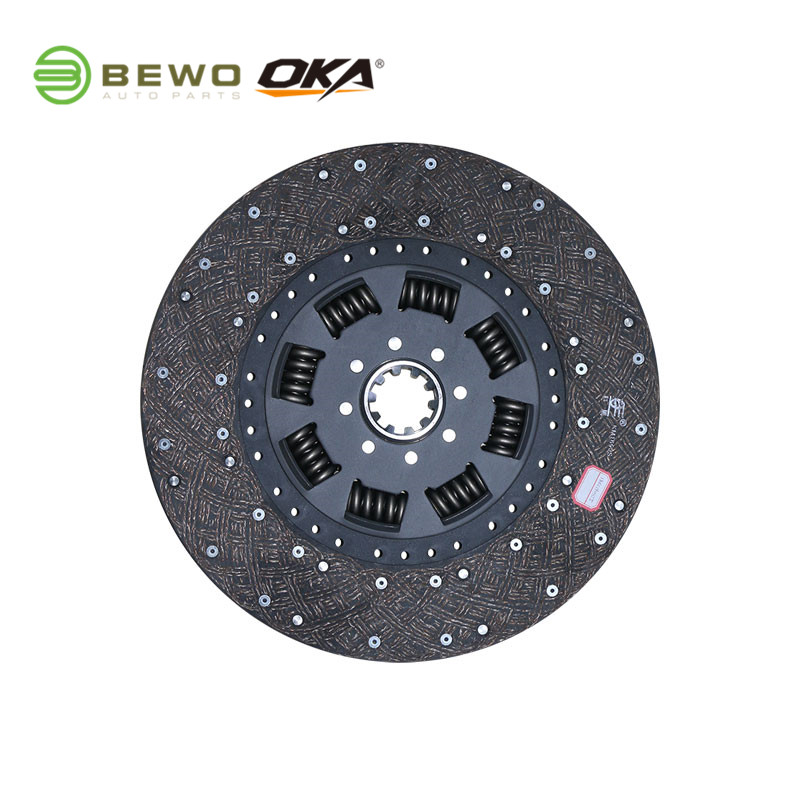
Sitting captive against the flywheel is the friction disc. This component features a splined center hub that slides directly over the transmission input shaft. Bolted over the top of this disc, directly to the flywheel, is the pressure plate assembly. When the system is fully engaged, the pressure plate exerts immense clamping force, squeezing the disc tightly against the flywheel. Because the disc is splined to the input shaft, this clamping action forces the truck's transmission to spin at the exact same speed as the engine.
The actuation sequence interrupts this power delivery to allow for gear changes. The process follows a specific mechanical path:
The driver depresses the pedal, pushing hydraulic fluid or engaging pneumatic assistance through the clutch master cylinder.
The slave cylinder/servo extends, pushing the release fork inside the bellhousing.
The release fork pushes the throw-out bearing directly into the diaphragm spring fingers of the pressure plate.
As these fingers are pushed inward, the internal mechanism pivots, lifting the heavy cast-iron friction ring away from the disc.
The clamping force drops to zero, the disc slides a fraction of a millimeter backward on the input shaft splines, and the transmission disconnects from engine rotation.
The friction disc functions as the primary interface within the manual or automated manual (AMT) transmission system. Its core responsibility is to grab the spinning flywheel and transfer massive rotational torque into the transmission without shattering under sudden, heavy loads. It achieves this through a combination of high-friction surface materials and a highly engineered structural core.
A vital feature for commercial discs is severe-duty torsional dampening. The center of the disc houses a series of heavy coil springs within a steel hub. These springs absorb the violent shock of engagement and smooth out the inherent torsional vibrations generated by large commercial diesel engines. Without a sprung hub, every gear shift would send a harsh shockwave through the transmission gears. Between the friction linings, engineers place a wavy piece of spring steel called a marcel spring, providing a smooth, progressive engagement for heavy loads.
For truck clutch parts wholesalers and fleet managers, matching the friction material to the application is critical. Manufacturers utilize several distinct compounds based on commercial hauling requirements.
Commercial Friction Material Application Guide
Material Type | Engagement Feel | Thermal Capacity | Best Commercial Application |
|---|---|---|---|
Organic | Smooth and progressive | Low to Medium | Light commercial trucks and city delivery fleets. |
Kevlar | Moderate, requires break-in | Medium to High | Regional transport fleets requiring extended service intervals. |
Ceramic / Metallic | Aggressive and sudden | Very High | Heavy towing, long-haul freight (Volvo/MAN rigs), and Shacman mining dump trucks. |
Sintered Iron | Extremely harsh | Extreme | Extreme gross-weight heavy haulage and specialized industrial vehicles. |
Heavy-duty European and Chinese specifications demand entirely different engineering tolerances compared to light vehicles. High-mass applications require immense structural rigidity to prevent the disc from warping or tearing apart under load. A transport truck hauling maximum legal weight requires a massive surface area to dissipate heat and hold torque. Utilizing a commercial-grade 430mm clutch friction disc provides the necessary structural integrity and thermal mass to survive sustained heavy hauling over steep grades—a perfect fit for high-torque applications in Mercedes-Benz, Volvo, Scania, MAN, Mack, Renault, and Shacman models.
The pressure plate, widely referred to in the commercial industry as the clutch cover, is the active clamping mechanism of the drivetrain. While the friction disc passively transfers power, the cover actively dictates exactly how much torque can be held before a fully loaded truck slips. It is a heavy, spring-loaded assembly bolted directly to the flywheel, rotating at engine speed.
The assembly consists of three primary structural components: the stamped steel or cast iron cover housing, the spring mechanism, and the cast iron friction ring. For trucks like Volvo and Mercedes, the cast iron ring is the surface that physically contacts the friction disc. It must be perfectly flat and capable of absorbing massive amounts of heat. Flexible steel drive straps connect the cast iron ring to the cover housing. Aggressive downshifting with heavy loads can bend these straps, causing the ring to hang up and create clutch drag.
For modern heavy-duty applications, engineers primarily utilize the Diaphragm Style cover. This is the modern standard for nearly all European heavy trucks and newer Shacman platforms. It utilizes a single, large Belleville-style spring. Diaphragm covers offer consistent, manageable pedal/servo operation, handle pneumatic assistance well, and provide uniform clamping pressure across the entire 430mm friction ring.
Upgrading or specifying the correct clamping force is a mandatory step for wholesalers supplying specialized fleets. Factory clamping force is engineered for factory torque ratings. If a fleet hauls over-dimensional loads, the standard cover may lack the physical strength to hold the disc, resulting in slip. Heavy-duty aftermarket covers utilize revised fulcrum points and stiffer diaphragm springs to increase the clamping load, often featuring enhanced ventilation for commercial continuous-duty cycles.
For repair shops and parts distributors, understanding the distinction between these two components requires evaluating their unique roles, material compositions, and thermal management strategies in a commercial environment.
The friction disc is responsible for passive friction generation. The cover is responsible for active mechanical force application. Without adequate clamping force, even the most aggressive ceramic friction material on a Mack or MAN truck will slip. Conversely, without high-quality friction material, massive clamping force will simply grind against bare metal, destroying the flywheel.
Heavy-Duty Component Comparison Matrix
Feature / Dimension | Clutch Plate (Friction Disc) | Pressure Plate (Clutch Cover) |
|---|---|---|
Primary Function | Transfers heavy diesel torque via friction material. | Applies immense mechanical clamping force. |
Material Composition | Composite organics, ceramic, Kevlar, stamped steel core. | Cast iron ring, heavy stamped steel housing, spring steel. |
Wear Mechanism | Physical abrasion of friction material (consumable for fleets). | Thermal fatigue, spring tension loss, surface scoring. |
Thermal Role | Generates heat during slip/engagement under load. | Absorbs and dissipates heat (massive heat sink). |
Failure Symptom | Slipping under heavy haulage load, burning smell. | Stiff pedal/servo, grinding gears, incomplete disengagement. |
Accurate diagnosis prevents unnecessary parts returns for wholesalers and reduces costly downtime for fleet operators. Because the assembly is buried inside a massive heavy-duty bellhousing, visual inspection is impossible without dropping a heavy commercial transmission. Mechanics must rely on tactile feedback and operational symptoms.
Symptoms of a failing friction disc are primarily related to a loss of friction. The most common indicator is the engine revving without a corresponding increase in vehicle speed, particularly when accelerating a fully loaded Scania or Renault rig in higher gears. Another symptom is shuddering or chattering during first-gear engagement, which often indicates the friction material has become contaminated with oil from a leaking rear main seal—a common issue in high-mileage commercial engines.
Symptoms of a failing cover manifest as mechanical actuation issues. If a fleet driver experiences difficulty shifting gears, or if the heavy-duty transmission grinds when selecting reverse, the cover is likely failing to fully disengage. This incomplete release happens when the cast iron ring warps from severe hauling heat or the internal pivot mechanism breaks.
Diagnosing a failed friction disc necessitates inspecting the entire assembly. If a disc slips, it generates massive heat, which permanently alters the metallurgy of the cover springs and warps the cast iron ring. Repair shops replacing only the disc while leaving a heat-damaged cover guarantees the new disc will fail prematurely. The truck's flywheel must also be inspected for runout, heat checking, and hot spots.
For truck clutch parts wholesalers and fleet procurement managers, selecting the correct drivetrain components requires moving beyond basic vehicle compatibility and analyzing the operational reality of commercial machines. The primary metric for selection is torque capacity. A Shacman dump truck operating in a quarry requires a significantly higher safety margin for torque capacity and debris resistance than a Renault delivery truck with the same engine block.
Commercial operations demand strict adherence to OEM durability metrics. For heavy transport, dimensional tolerances and load ratings dictate service life. When outfitting a fleet or stocking a repair shop inventory, sourcing a precision-manufactured 400mm truck clutch plate or 430mm variant ensures the splines align flawlessly with the transmission input shaft, reducing premature wear. The heavy-duty dampening springs in these specific commercial plates are calibrated to handle the aggressive torque pulses of European and domestic diesel engines, preventing catastrophic hub failure under load.
Wholesalers building their catalogs must carry rigorously tested components. Supplying a premium Mercedes Benz truck clutch disc, alongside equivalents for Volvo, Scania, MAN, Mack, Renault, and Shacman, ensures seamless compatibility with factory dual-mass or solid flywheels and original pneumatic release systems.
Regardless of the specific truck brand, B2B industry best practice mandates replacing the entire assembly at once. Wholesalers should encourage repair shops to purchase complete, matched clutch kits. The labor cost to drop a commercial transmission far exceeds the cost of the parts. Replacing the friction disc, cover, pilot bearing, and release bearing simultaneously eliminates secondary labor costs for the fleet and guarantees all mating surfaces are perfectly matched from day one.
Wholesalers and fleets must calculate the truck's peak engine torque and gross vehicle weight (GVW) before specifying replacement commercial drivetrain components.
Repair shops must inspect the heavy-duty flywheel surface for heat checking and measure runout prior to installing new parts.
Source a complete, matched clutch kit (friction disc, pressure plate/cover, and release bearings) designed specifically for major European and domestic heavy trucks to avoid mismatched tolerances and costly returns.
Always inspect the pneumatic/hydraulic clutch servo system to ensure full disengagement and prevent premature drag on the new assembly.
A: It is highly discouraged in the commercial trucking industry. A worn friction disc usually indicates the heavy-duty pressure plate has also endured significant thermal stress and millions of actuation cycles. Reusing an old pressure plate risks weak clamping force, leading to immediate slipping and costly truck downtime. Always sell and install them as a complete kit.
A: Under normal long-haul conditions in trucks like a Volvo FH or Mercedes Actros, both components are designed for high mileage, often exceeding hundreds of thousands of kilometers depending on the transmission type (manual vs. AMT). They wear at similar rates. Heavy quarry work in a Shacman will significantly reduce this lifespan compared to highway freight.
A: Extreme heat from hauling heavy loads is the primary culprit. When the system slips excessively due to driver error, severe overloading, or worn friction material, it generates massive thermal energy. This heat permanently alters the temper of the diaphragm spring, causing it to lose tension, and warps the cast iron friction ring.
A: An aggressive ceramic friction disc used in heavy haulage requires high clamping force to bite effectively. If a shop uses a stock pressure plate, it will not squeeze hard enough, causing the aggressive material to slip and rapidly chew through the truck's flywheel. Upgrading the pressure plate ensures adequate holding power for the heavy-duty material.
A: Not necessarily. A severe-duty pressure plate prevents slipping under heavy commercial loads by applying more force, which actually protects the friction disc from heat damage. However, the increased clamping load must be matched with appropriate pneumatic assist servos to avoid damaging the release mechanisms.
A: A sprung disc features heavy-duty coil springs in the center hub to absorb massive diesel drivetrain shock and reduce vibration. Rigid discs lack these springs and are generally unsuitable for commercial freight applications, as they would transfer destructive torsional vibrations directly into the truck's transmission.


