

Views: 0 Author: Site Editor Publish Time: 2026-07-01 Origin: Site


A failed commercial drivetrain presents compounding financial and operational risks that extend far beyond the initial breakdown. When a transmission is pulled, the steep labor costs and fleet downtime incurred are devastating to operational schedules. Sourcing incomplete or mismatched replacement parts only magnifies these risks, leading to repeated failures, extended shop time, and frustrated drivers. There is common industry confusion surrounding what constitutes a truly complete replacement set. The false economy of piecemeal component replacement pales in comparison to the long-term reliability of installing a unified, pre-matched truck clutch assembly. Replacing only the worn friction disc while leaving fatigued springs in the pressure plate guarantees premature failure and secondary teardowns. Understanding the exact components, material specifications, and application-specific requirements of a high-quality clutch kit is mandatory for fleet managers, owner-operators, and technicians seeking to optimize fleet longevity and keep trucks on the road.
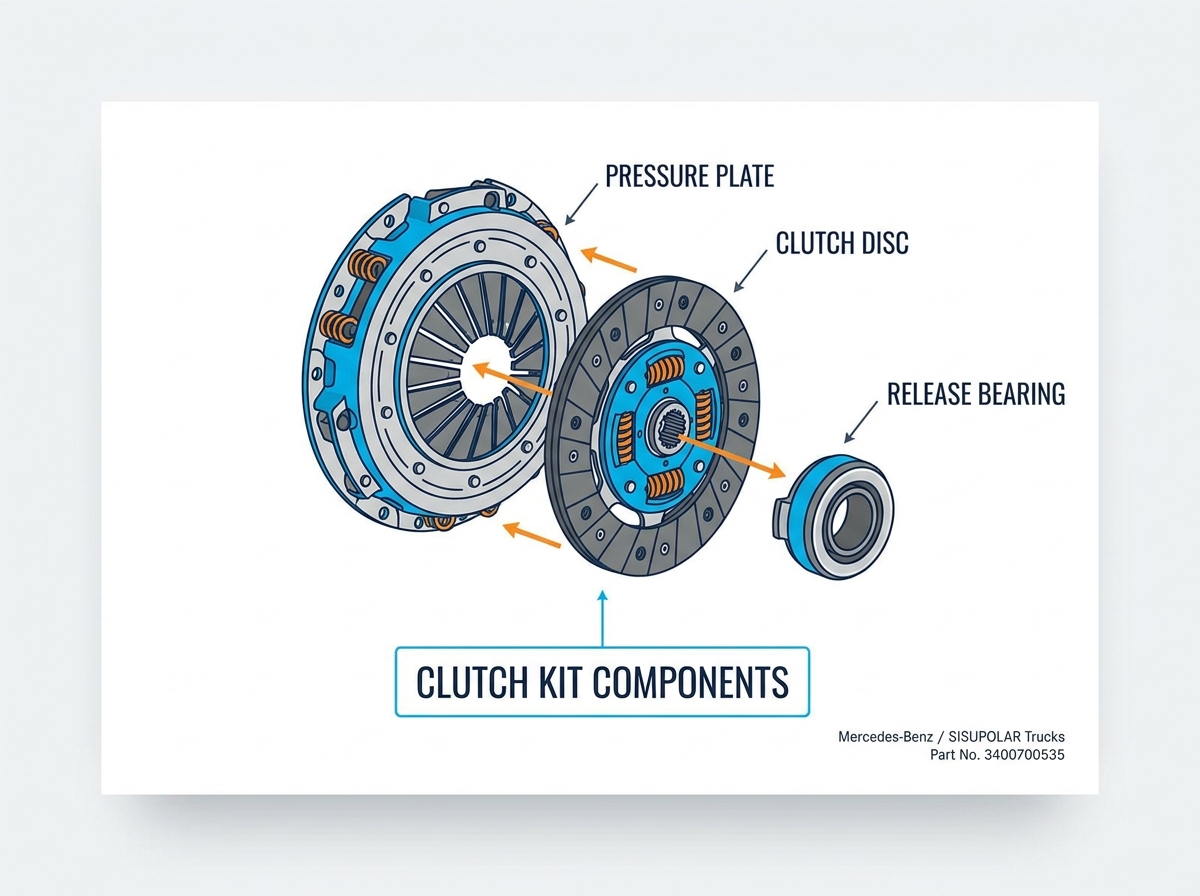
A standard complete assembly must include, at minimum, the clutch disc, pressure plate, and release bearing; omitting any of these compromises the entire repair.
Heavy-duty applications require specialized friction materials, advanced torsional dampening, and higher clamp loads to manage extreme torque without excessive pedal effort.
Application-specific matching is non-negotiable; utilizing precise OEM cross-reference part numbers ensures compatibility with complex engine and transmission mating interfaces.
Replacing individual worn parts rather than installing a comprehensive clutch kit drastically increases the probability of premature failure and secondary labor costs.
The clutch disc acts as the primary friction interface between the engine flywheel and the transmission input shaft. It transfers rotational energy from the engine block to the driveline while allowing for smooth engagement and disengagement during gear shifts. The structural integrity of this disc dictates how effectively power is transmitted under heavy loads.
Material variations directly impact engagement smoothness, thermal capacity, and torque transfer. Organic materials offer smooth engagement for lighter duties but degrade rapidly under high heat. Ceramic, Kevlar, and metallic compounds handle higher heat and torque, making them ideal for severe applications where slipping would destroy standard organic pads. The choice of friction material dictates the operational limits of the vehicle.
Torsional dampening springs within the disc hub absorb engine firing pulses. They protect transmission gear teeth from destructive shock loads during engagement. Without these heavy-duty springs, the harsh vibrations from a diesel engine would shear the input shaft splines or shatter the transmission gears over time.
The pressure plate assembly provides the clamping mechanism that forces the clutch disc against the flywheel. This locks the engine and transmission at the same rotational speed. The assembly consists of a heavy iron casting, a stamped steel cover, and the internal spring mechanism that applies the clamping force.
Diaphragm spring designs are common in light-to-medium duty applications, offering consistent pedal feel and fewer moving parts. Coil spring and lever designs are frequently utilized in heavy-duty commercial vehicles for higher clamp loads. These lever designs allow for mechanical advantage, applying massive pressure to the friction disc without requiring superhuman leg strength from the driver.
Pressure plate metallurgy and casting thickness affect heat dissipation. Thicker, high-quality castings resist thermal warping under heavy load conditions, ensuring a flat mating surface. If the casting warps, the clutch will chatter violently upon engagement, leading to immediate driver complaints and eventual driveline damage.
The release bearing functions by translating pedal stroke into mechanical force against the pressure plate diaphragm or release levers, disengaging the clutch. It rides on the transmission input shaft retainer and spins only when the clutch pedal is depressed, taking the thrust load of the pressure plate springs.
Standard mechanical bearings, constant-running bearings, and integrated concentric slave cylinders (CSC) serve different system designs. CSCs combine the bearing and hydraulic slave cylinder into one unit, eliminating the traditional clutch fork and pivot ball. This reduces external moving parts but requires opening the hydraulic system during replacement.
Replacing this component is non-negotiable during a teardown. Bearing failure often leads to catastrophic damage to the pressure plate diaphragm fingers, destroying the entire assembly. A seized release bearing will machine its way through the pressure plate fingers in a matter of miles, leaving the truck stranded.
The pilot bearing or bushing plays a critical role in supporting the snout of the transmission input shaft within the engine crankshaft flange. It keeps the shaft centered during operation, preventing it from wobbling when the clutch is disengaged.
Omitting this inexpensive part during a clutch kit installation results in catastrophic transmission damage. Input shaft runout, spline wear, and gear misalignment occur rapidly when the shaft lacks proper support. The resulting vibrations will destroy the transmission front seal and input bearing.
Premium kits include a packet of high-temperature, high-pressure grease, typically lithium or synthetic-based. This specialized lubricant is essential for proper installation and long-term operation. Standard chassis grease will melt and contaminate the friction disc.
Applying the correct amount of specialized grease prevents spline corrosion. It ensures smooth axial movement of the clutch disc along the input shaft, preventing drag and shifting issues. Too much grease will spin off centrifugally and ruin the new clutch; too little will cause the disc to hang up on the splines.
The splined alignment tool is necessary for centering the clutch disc perfectly with the pilot bearing during pressure plate torquing. Without it, installing the transmission becomes nearly impossible, as the input shaft will not slide through the disc hub and into the pilot bearing.
While inexpensive, its inclusion is a hallmark of a comprehensive, installer-focused package. It saves technicians significant time and frustration during reassembly. Using a universal alignment tool often leads to slight misalignments, requiring the technician to wrestle the heavy transmission into place.
Twin-disc setups are necessary in a heavy-duty truck clutch to handle massive torque outputs, often exceeding 1,500 lb-ft. They achieve this without increasing the bellhousing envelope size. By doubling the friction surface area, the assembly can hold significantly more power without requiring a larger diameter flywheel.
The intermediate plate, or floater plate, sits between the two friction discs. It provides an additional friction surface and significantly affects heat dissipation during heavy-haul starts. This thick iron plate absorbs and dissipates the massive thermal loads generated when moving 80,000 pounds from a dead stop.
Push-type systems operate by having the bearing push the diaphragm spring inward toward the engine. Pull-type systems, common in heavy commercial vehicles, operate by having the bearing pull the release fingers outward toward the transmission. Pull-type designs generally offer higher clamp loads for a given pedal effort.
Pull-type heavy-duty truck clutch assemblies require unique installation steps. They utilize specialized release bearing locking rings that must be properly engaged to function correctly. The technician must snap the release bearing into the pressure plate after the transmission is bolted to the engine block.
Modern high-torque, low-RPM diesel engines produce severe low-frequency harmonics. Specific engineering, including upgraded torsional dampers, is required to mitigate these destructive vibrations. These dampers use multiple stages of springs to absorb different frequencies of engine vibration.
Commercial transport applications require careful evaluation between rigid hubs and multi-stage sprung hubs. Sprung hubs offer better dampening, protecting the driveline from shock loads. Rigid hubs are generally reserved for agricultural or extreme off-road applications where spring failure is a higher risk than driveline vibration.
While flywheels are rarely included in a standard clutch kit, they must be resurfaced or replaced simultaneously. This ensures the proper friction coefficient and adequate heat transfer. Installing a new clutch against a glazed or heat-checked flywheel guarantees immediate slipping and shuddering.
Conversion kits, such as dual-mass to single-mass flywheel conversions, are sometimes appropriate for fleet longevity. They eliminate the complex dual-mass system, often increasing reliability in heavy-use scenarios. Single-mass flywheels are solid pieces of steel or iron that cannot fail internally, unlike their dual-mass counterparts.
Balancing the need for high torque holding capacity against driver fatigue requires a solid decision framework. Higher clamp loads prevent slipping but increase the effort required to depress the pedal. Over-specifying a clutch can lead to driver knee and back issues over long hauls.
Self-adjusting technology (SAC) plays a crucial role in maintaining consistent pedal effort. It adjusts for wear, keeping clutch travel consistent over the service life of the friction material. As the disc wears thinner, the internal mechanism ratchets to maintain the exact same diaphragm spring angle.
Friction material choices map directly to specific operational outcomes. Ceramic button discs excel in high-heat, frequent stop-and-go heavy hauling environments. They bite hard and resist fading even when the assembly is glowing hot from repeated hill starts.
Organic materials provide smooth engagement and are better suited for lighter delivery applications where extreme heat is less of a concern. They are forgiving and easy to modulate, making them ideal for city delivery trucks that do not pull heavy trailers.
Friction Material | Engagement Feel | Heat Tolerance | Best Application |
|---|---|---|---|
Organic | Smooth | Low to Medium | Light delivery, standard street use |
Kevlar | Moderate | Medium to High | Mixed fleet, moderate towing |
Ceramic | Aggressive | Very High | Heavy hauling, severe duty |
Sintered Iron | Harsh | Extreme | Off-road, agricultural, competition |
Zero-balance or pre-balanced assemblies are vital for preventing destructive driveline vibrations. Imbalanced units cause premature wear on surrounding components. A pressure plate that is out of balance will shake the entire cab at specific RPM ranges.
Proper dynamic balancing protects crankshaft main bearings and transmission input bearings from fatigue, ensuring the entire drivetrain operates smoothly. Manufacturers achieve this by drilling small holes or adding welded weights to the pressure plate cover during final assembly.
European heavy-duty automated manual transmissions (AMTs) require strict OEM tolerances and performance specifications. They demand higher precision than traditional manual gearboxes to ensure smooth automated shifts. The pneumatic actuators in an AMT cannot compensate for a grabbing or dragging clutch the way a human driver can.
The Clutch Kit 3400700535 for Mercedes-Benz And SISUPOLAR Trucks serves as a prime example of highly specialized, heavy-duty engineering designed for specific driveline architectures.
This 3-piece heavy-duty clutch kit includes a 430mm pull-type pressure plate, a high-torsion sprung clutch disc, and an integrated release bearing. Each component is engineered for extreme durability under continuous heavy loads.
Technical requirements are stringent to meet the immense torque demands of Mercedes-Benz Actros/Arocs and SISUPOLAR trucks powered by OM501LA/OM502LA and OM471/OM473 engines. These powerplants generate massive low-end torque that will instantly destroy substandard friction materials.
Using generic, multi-fit alternatives instead of an exact-match Clutch Kit 3400700535 carries extreme operational risks. Immediate slippage, transmission damage, and voided warranties are common consequences of improper matching. The spline count, hub depth, and release bearing travel must be exact to the millimeter.
Mating a new clutch disc to an old pressure plate leads to uneven wear and localized hot spots. The old pressure plate surface is rarely perfectly flat, having coned or warped during its previous service life.
This practice causes rapid friction glaze and immediate warranty voidance. A complete kit installation is the only way to guarantee proper mating surfaces and clamp load. The labor cost to pull a heavy-duty transmission far outweighs the savings of reusing an old pressure plate.
Hanging the transmission on the input shaft bends the disc carrier, ruining the new clutch instantly. Proper transmission jacks and support are mandatory. Technicians must ensure the transmission is perfectly aligned with the engine block before sliding it forward.
Over-lubricating splines contaminates friction linings, causing slipping. Improper star-pattern torquing of the pressure plate warps the housing, leading to engagement issues. Bolts must be tightened in a crisscross pattern to the exact foot-pounds specified by the manufacturer.
Inspect the flywheel for heat checks, cracks, and runout. Resurface or replace as necessary.
Install the new pilot bearing using a proper seal driver to avoid damaging the rollers.
Clean the transmission input shaft splines and apply a light coat of the provided high-temp grease.
Use the alignment tool to center the friction disc against the flywheel.
Install the pressure plate, hand-tightening bolts before torquing in a star pattern to OEM specs.
Necessary break-in procedures typically involve 500 miles or 1,000 stop-and-start cycles. This period allows the friction surfaces to properly mate and seat, transferring a thin layer of friction material to the flywheel and pressure plate.
Applying heavy loads, steep grades, or aggressive slipping immediately after installation risks glazing the friction material. Glazed material loses its friction coefficient, causing permanent slipping. Drivers must be instructed to shift smoothly and avoid heavy towing during this critical window.
Sourcing a comprehensive, high-quality clutch kit is the only technically sound approach to driveline repair. It maximizes uptime and ensures reliable operation across the entire fleet.
Verify the inclusion of all primary components, including the disc, pressure plate, release bearing, pilot bearing, and spline lubricant. Match the friction material to the vehicle's actual duty cycle and strictly adhere to OEM part number cross-references.
Consult your vehicle's service manual for specific torque sequences. Verify flywheel runout before assembly, and source parts from certified distributors who provide comprehensive warranty coverage.
A: No, most standard kits do not include a flywheel. The existing flywheel must be resurfaced or replaced separately during the clutch installation to ensure a proper mating surface and correct friction coefficient.
A: A 3-piece kit typically includes the friction disc, pressure plate, and release bearing. A 4-piece kit adds a pilot bearing or bushing to the package, which supports the input shaft.
A: No. Reusing an old pressure plate compromises the new disc. The spring tension degrades over time, and the surface is likely warped or heat-checked, leading to premature failure and uneven wear.
A: Immediate slipping is often caused by grease contamination on the friction material, an improperly machined flywheel, or using a kit with insufficient clamp load for the specific vehicle application.
A: Yes. The alignment tool centers the disc with the pilot bearing. Without it, the transmission input shaft will not slide into the clutch assembly during installation, making reassembly impossible.


